


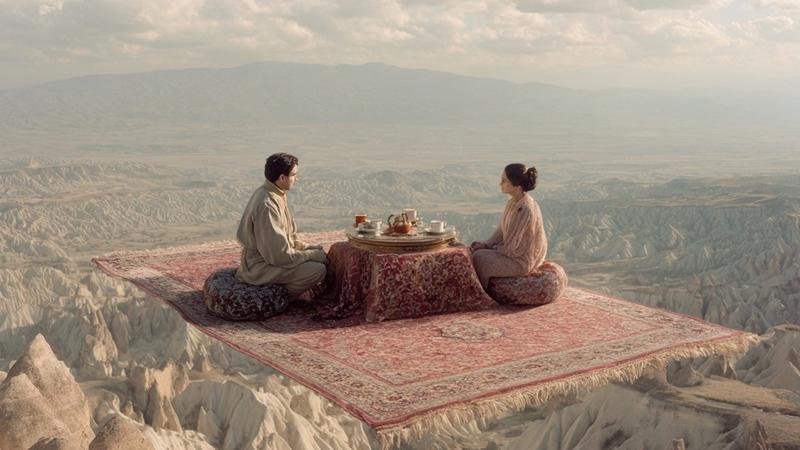
Imagine that you are going to meet someone for coffee: maybe it’s a new business relationship, maybe it’s a first date.
What do you think about? The location? Timing? How you will get there? The topics of conversation? What you will wear?
What if you thought of it as a piece of experience design? What if you thought about the other person’s experience in every detail, end-to-end (and of course their experience extends beyond the meeting; the invitation, the confirmation, the follow-up)? If you were to draw their experience of the meeting minute-by-minute how would it look? Like a roller-coaster? What would be the highlights? What would they remember?
Perhaps your invitation would be out of the ordinary, something to make you stand out from the crowd. Perhaps it would be personalised in some way – demonstrating that you have taken the time to learn about them and take them into consideration. Perhaps you would arrive before them, and maybe you would carefully consider the first impression you make. You might think about how to make them feel at ease, and how to make space for them to talk about what really matters to them. You might also think about ‘surprise & delight’ - the things that would stick, and the story they would tell the first person who asks ‘so how did it go?’. What would you want them to say?
I know what you are thinking: you are thinking that you couldn’t possibly do all this without knowing an awful lot about the person. You’re right - designing an experience requires knowing your audience: some people like museums, some like football matches. Some even like country and western songs.
In learning, what we call ‘experience design’ has suffered from educational baggage: we immediately picture a trainer clasping their hands and saying ‘and now we’re going to do an activity…’. But an experience could be an email in your inbox asking you to decide if someone is right for a role, it could be interviewing someone from a different background, chatting with an AI companion, or trying something you have never done before.
The essence of an experience is always the same: it moves you. Memory stores only what matters, what matters is the stuff that moves us. You can’t call something ‘an experience’ if you didn’t remember it at all.
An experience design has three parts:
- What matters to people today (the starting point)
- Where we want to move them to (the destination)
- The experience that will take them from 1) to 2)
It sounds deceptively simple, but today we have barely scratched the surface of what is possible. Here’s a real example:
A multinational oil & gas company wanted operational teams to care more about safety. The modules they designed explained the risks of unsafe working practices and the operating procedures intended to mitigate those risks. Workers completed the modules, unexpectedly accident reports went up not down.
Talking to the audience revealed that many workers cared about appearing ‘super human’. By describing risky behaviours the modules inadvertently provided people with a shopping list of things to do if people wanted to prove their worth via their dare-devil exploits. Now that you know what the audience cares about how would you change the experience to achieve the desired outcome?
Another example: in Dan & Chip Heath’s book ‘The Power of Moments’ they describe the ‘Magic Castle Hotel’ in Los Angeles – a modest hotel that far exceeds luxury competitors in customer rating terms. The secret? A quirky and delightful experience – a bell that you can ring 24x7 for a butler to appear with a selection of snacks for example. The Four Seasons designed a pleasant but dull experience. Like most training programmes it was quickly forgotten, and did not translate into behaviour change (positive reviews) as might have been hoped.
It’s not enough for a learner experience to gimmicky; but only the aspects of the experience that depart from the script – that put people in a space where they are surprised, or challenged, or delighted, or moved – only these are remembered, and only these have the potential to change behaviour.
The job of an experience designer is to move the audience towards the destination – whether that is better TripAdvisor reviews or Safer Operating Procedures – but experience design is first and foremost a mindset.